

In 1999, the Philadelphia chemical giant Rohm & Haas acquired Morton International for $4.9 billion in cash and stock — a 43 percent premium over the pre-announcement share price — and the Morton family name was legally separated from the industrial enterprise that had carried it for more than a century. The blue canister remained. The umbrella girl remained. The slogan remained. The family did not. At its peak, the company that Joy Morton had built from a $10,000 investment in a Chicago salt agency in 1880 controlled at least a third of America's entire salt supply — a dominance so comprehensive that the Supreme Court's 1948 ruling against the company in FTC v. Morton Salt became a foundational precedent in American antitrust law, still cited in scholarship today. The Morton Salt Girl, first introduced in 1914, was ranked number 9 on AdAge's authoritative list of the Top 10 Advertising Slogans of the 20th Century. And the family that created her traces its American roots to a French Huguenot minister who survived the St. Bartholomew's Day Massacre of 1572, and its industrial empire to a patriarch who was expelled from the University of Michigan twice, lost four consecutive gubernatorial elections, founded Arbor Day, served as United States Secretary of Agriculture, and died editing a libertarian newspaper funded by his sons.
———————————————————
Gain FREE access to secret full-length documentaries on wealthy families "too scandalous for YouTube" by joining our newsletter: https://www.substack.com/@oldmoneyluxury
———————————————————
Julius Sterling Morton was born in 1832 in Adams, Jefferson County, New York, the eldest of three children — and was expelled from the University of Michigan twice before his 1854 graduation date for "general remissness and inattention to all his college duties," eventually receiving his degree only in 1858 after the controversy had cooled.
He married Caroline Joy French in October 1854, and on the very day of their wedding the newlyweds departed for the Nebraska Territory — purchasing 160 acres of windswept prairie outside Nebraska City in 1855 for $200, and building a modest four-room frame house that they would remodel seven times into the eventual 52-room Arbor Lodge mansion.
Over fifty years, the Mortons introduced more than 270 varieties of trees and shrubs to the property, including at least ten specimens that would qualify as Nebraska state-champion trees — and on January 4, 1872, J. Sterling Morton stood before the Nebraska State Board of Agriculture and proposed the resolution that created Arbor Day.
Nebraska held its first Arbor Day on April 10, 1872, with estimates placing the total number of trees planted that day at over one million — and today it is observed in all fifty states and in multiple countries worldwide.
Morton ran four times for the Nebraska governorship between 1866 and 1892 and lost every time — a Civil War-era Democrat who had opposed Lincoln, his political ambitions were permanently capped by the Union patriotism of frontier Nebraska — but in 1893 President Grover Cleveland appointed him Secretary of Agriculture, a position he held until 1897.
His eldest son Joy Morton, born in 1855, entered the salt business in 1880 by investing $10,000 in the Chicago salt agency E.I. Wheeler & Co. — and within five years had taken over and renamed it Joy Morton & Company, beginning the consolidation that would build one of the most powerful commodity monopolies in American history.
By the early 20th century, Morton Salt produced upwards of 600,000 tons of evaporated salt annually plus an additional 400,000 tons of rock salt — controlling at least a third of America's entire salt supply, and operating at the center of an industry that federal regulators repeatedly found was organized around systematic price-fixing and market allocation.
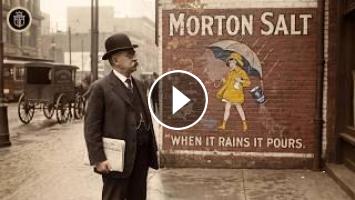
In 1914, a Good Housekeeping advertisement introduced the Morton Salt Girl — the umbrella, the blue canister, the rain, the freely flowing salt — and the slogan "When it rains it pours," which AdAge later ranked number nine on its definitive list of the Top 10 Advertising Slogans of the 20th Century.
Joy Morton founded the Morton Arboretum in Lisle, Illinois, in 1922 — endowing it with 735 acres and laying the groundwork for what is now one of the most significant arboreta in the world.
In 1948, the U.S. Supreme Court ruled against Morton Salt in FTC v. Morton Salt Co. — a foundational antitrust decision establishing that discriminatory pricing could be presumed harmful without proof of actual competitive injury, still cited in antitrust scholarship today.
———————————————————
Gain FREE access to secret full-length documentaries on wealthy families "too scandalous for YouTube" by joining our newsletter: https://www.substack.com/@oldmoneyluxury
———————————————————
Julius Sterling Morton was born in 1832 in Adams, Jefferson County, New York, the eldest of three children — and was expelled from the University of Michigan twice before his 1854 graduation date for "general remissness and inattention to all his college duties," eventually receiving his degree only in 1858 after the controversy had cooled.
He married Caroline Joy French in October 1854, and on the very day of their wedding the newlyweds departed for the Nebraska Territory — purchasing 160 acres of windswept prairie outside Nebraska City in 1855 for $200, and building a modest four-room frame house that they would remodel seven times into the eventual 52-room Arbor Lodge mansion.
Over fifty years, the Mortons introduced more than 270 varieties of trees and shrubs to the property, including at least ten specimens that would qualify as Nebraska state-champion trees — and on January 4, 1872, J. Sterling Morton stood before the Nebraska State Board of Agriculture and proposed the resolution that created Arbor Day.
Nebraska held its first Arbor Day on April 10, 1872, with estimates placing the total number of trees planted that day at over one million — and today it is observed in all fifty states and in multiple countries worldwide.
Morton ran four times for the Nebraska governorship between 1866 and 1892 and lost every time — a Civil War-era Democrat who had opposed Lincoln, his political ambitions were permanently capped by the Union patriotism of frontier Nebraska — but in 1893 President Grover Cleveland appointed him Secretary of Agriculture, a position he held until 1897.
His eldest son Joy Morton, born in 1855, entered the salt business in 1880 by investing $10,000 in the Chicago salt agency E.I. Wheeler & Co. — and within five years had taken over and renamed it Joy Morton & Company, beginning the consolidation that would build one of the most powerful commodity monopolies in American history.
By the early 20th century, Morton Salt produced upwards of 600,000 tons of evaporated salt annually plus an additional 400,000 tons of rock salt — controlling at least a third of America's entire salt supply, and operating at the center of an industry that federal regulators repeatedly found was organized around systematic price-fixing and market allocation.
In 1914, a Good Housekeeping advertisement introduced the Morton Salt Girl — the umbrella, the blue canister, the rain, the freely flowing salt — and the slogan "When it rains it pours," which AdAge later ranked number nine on its definitive list of the Top 10 Advertising Slogans of the 20th Century.
Joy Morton founded the Morton Arboretum in Lisle, Illinois, in 1922 — endowing it with 735 acres and laying the groundwork for what is now one of the most significant arboreta in the world.
In 1948, the U.S. Supreme Court ruled against Morton Salt in FTC v. Morton Salt Co. — a foundational antitrust decision establishing that discriminatory pricing could be presumed harmful without proof of actual competitive injury, still cited in antitrust scholarship today.
- Category
- Documentaries
- Tags
- old money, old money documentaries, wealthy family documentaries
Post your comment
Up Next
Autoplay
-
"The People who I can make Anime with are Disappearing."
-
The housewife everyone mocked was an ancient immortal ancestor controlling the family’s destiny!
-
TRUMPS NOT AFRAID TO TAKE RISK! HE'S GREAT! #america #trump #politics #family #news #foxnews
-
Nepal Is Disappearing: The End of a Country Beneath the Himalayas | 4K Documentary
-
Oskar's America | Family Adventure Movie | Free
-
EveryLady In America Will Cry SAD Tears While Watching This LifeChanging Family Movie-African Movies
-
Could The Government SEIZE Your XRP… Then Reprice It OVERNIGHT?
-
XRP OVERNIGHT THIS IS IT !!!! XRP $1000 PRICE GLITCH !!!!
-
The Controlling Squirrel!????| Arpo & Daniel Robo Adventures | Funny Cartoons for Kids
-
The Dog Ran Across America to Find His Boy | City Dog | Full Free Family Movie
-
A MOVIE YOU'LL ENJOY EVERY TIME YOU WATCH IT! | Action, Crime Movies in English | HD
-
End Of The World FULL MOVIE | Disaster Movies | The Midnight Screening
-
Jason Statham In SERIAL KILLER – Hollywood English Movie | Superhit Crime Action Film | Free Movies
-
DON’T OPEN THE DOOR FOR HER | Horror Thriller Full Movie | Evil, Fear, Madness
-
The Sharks Return to Finish | Best horror movie | Free full movies on youtube in English 4K
-
Ong Bak 3 Full Movie Review & Facts | Tony Jaa, Dan Chupong, Primorata Dejudom
-
Liz: The Elizabeth Taylor Story | FULL MOVIE | Sherilyn Fenn, Ray Wise, John Saxon | Biography
-
FOOLPROOF - Ryan Reynolds In Hollywood English Movie | Blockbuster Heist Action English Full Movie
-
An Egypt Affair | ROMANCE | Full Movie in English
-
Dil Hai Tumhaara (2002) - Full Movie HD - Rekha, Arjun Rampal, Preity Zinta, Mahima Chaudhry










 Loading...
Comments