

The lives of nomads are completely subordinated to the rhythms of nature and the care of their livestock. The Gobi Desert is not only sand dunes but also endless rocky steppes, semi-deserts, and foothills, where every patch of grass matters.
The Nomad's Main Companions: "Five Types of Livestock"
A family's well-being depends on its herd, which traditionally consists of five species:
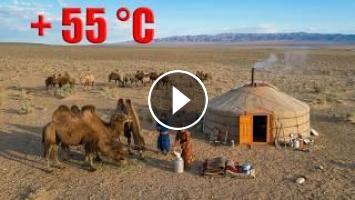
Bactrian Camels: The Gobi Desert's greatest treasure. They provide wool and milk for making nutritious kumiss and traditional cheeses (aaruul), and serve as indispensable transport for transporting yurts over long distances.
Horses: A symbol of Mongolian culture and the pride of any nomad.
Sheep and Goats: A source of meat, milk, and wool for felting.
Cattle (cows, yaks): Found closer to the mountainous regions.
Traditional Dwelling: Mongolian Yurt (Ger)
The yurt is a masterpiece of nomadic architecture, perfectly adapted to the harsh winds and temperature fluctuations of the Gobi Desert.
Mobility: The wooden lattice and felt structure can be assembled and disassembled in just one or two hours. This allows the family to change location several times a year in search of better pastures.
Climate Control: The yurt is cool in the summer, and in the winter, the felt walls retain heat from the fireplace.
Orientation: The yurt door always faces south, providing protection from cold northern winds and serving as a natural sundial.
Modern Gobi nomads cherish their traditions while skillfully incorporating modern technology: solar panels, satellite dishes, and motorcycles are often found near the yurt, helping to herd herds across the vast horizons.
#desert #camels #Mongolia
The Nomad's Main Companions: "Five Types of Livestock"
A family's well-being depends on its herd, which traditionally consists of five species:
Bactrian Camels: The Gobi Desert's greatest treasure. They provide wool and milk for making nutritious kumiss and traditional cheeses (aaruul), and serve as indispensable transport for transporting yurts over long distances.
Horses: A symbol of Mongolian culture and the pride of any nomad.
Sheep and Goats: A source of meat, milk, and wool for felting.
Cattle (cows, yaks): Found closer to the mountainous regions.
Traditional Dwelling: Mongolian Yurt (Ger)
The yurt is a masterpiece of nomadic architecture, perfectly adapted to the harsh winds and temperature fluctuations of the Gobi Desert.
Mobility: The wooden lattice and felt structure can be assembled and disassembled in just one or two hours. This allows the family to change location several times a year in search of better pastures.
Climate Control: The yurt is cool in the summer, and in the winter, the felt walls retain heat from the fireplace.
Orientation: The yurt door always faces south, providing protection from cold northern winds and serving as a natural sundial.
Modern Gobi nomads cherish their traditions while skillfully incorporating modern technology: solar panels, satellite dishes, and motorcycles are often found near the yurt, helping to herd herds across the vast horizons.
#desert #camels #Mongolia
- Category
- Documentaries
- Tags
- Asia, Gobi, Mongolia
Post your comment
Up Next
Autoplay
-
???? ADRIFT: SILENCE OF THE ENDLESS SEA | 2026 Full Movie | 4K Cinematic Survival Thriller | Action
-
Swiss Family Robinson 1960 – One Family. One Island. Endless Adventure – Full Movies
-
Namibia (Full Episode) | The Survival Battle in the Deadliest Desert | nature documentary
-
Black Hat USA 2026 Business Hall: Meet The World's Hottest Cybersecurity Companies
-
World's Deadliest: Survival Challenges in Animal Kingdom | Nature Animal Documentary
-
WILD YUKON | Migration and the Endless Fight for Survival | Nature Animal Documentary
-
???? RUST SEA: The Last Wanderer | Post-Apocalyptic Desert Survival | 2026 Full Movie | English | 4K
-
Survival: Desert Island | 2026 Full Movie | English | Adventure | Action
-
Botswana (Full Episode) | Survival Battles in the World’s Deadliest Migration | nature documentary
-
The World Has a Board of Directors- ROTHSCHILD FAMILY | Full Documentary
-
A MOVIE YOU'LL ENJOY EVERY TIME YOU WATCH IT! | Action, Crime Movies in English | HD
-
End Of The World FULL MOVIE | Disaster Movies | The Midnight Screening
-
Jason Statham In SERIAL KILLER – Hollywood English Movie | Superhit Crime Action Film | Free Movies
-
DON’T OPEN THE DOOR FOR HER | Horror Thriller Full Movie | Evil, Fear, Madness
-
The Sharks Return to Finish | Best horror movie | Free full movies on youtube in English 4K
-
Ong Bak 3 Full Movie Review & Facts | Tony Jaa, Dan Chupong, Primorata Dejudom
-
Liz: The Elizabeth Taylor Story | FULL MOVIE | Sherilyn Fenn, Ray Wise, John Saxon | Biography
-
FOOLPROOF - Ryan Reynolds In Hollywood English Movie | Blockbuster Heist Action English Full Movie
-
An Egypt Affair | ROMANCE | Full Movie in English
-
Dil Hai Tumhaara (2002) - Full Movie HD - Rekha, Arjun Rampal, Preity Zinta, Mahima Chaudhry







 Loading...
Comments